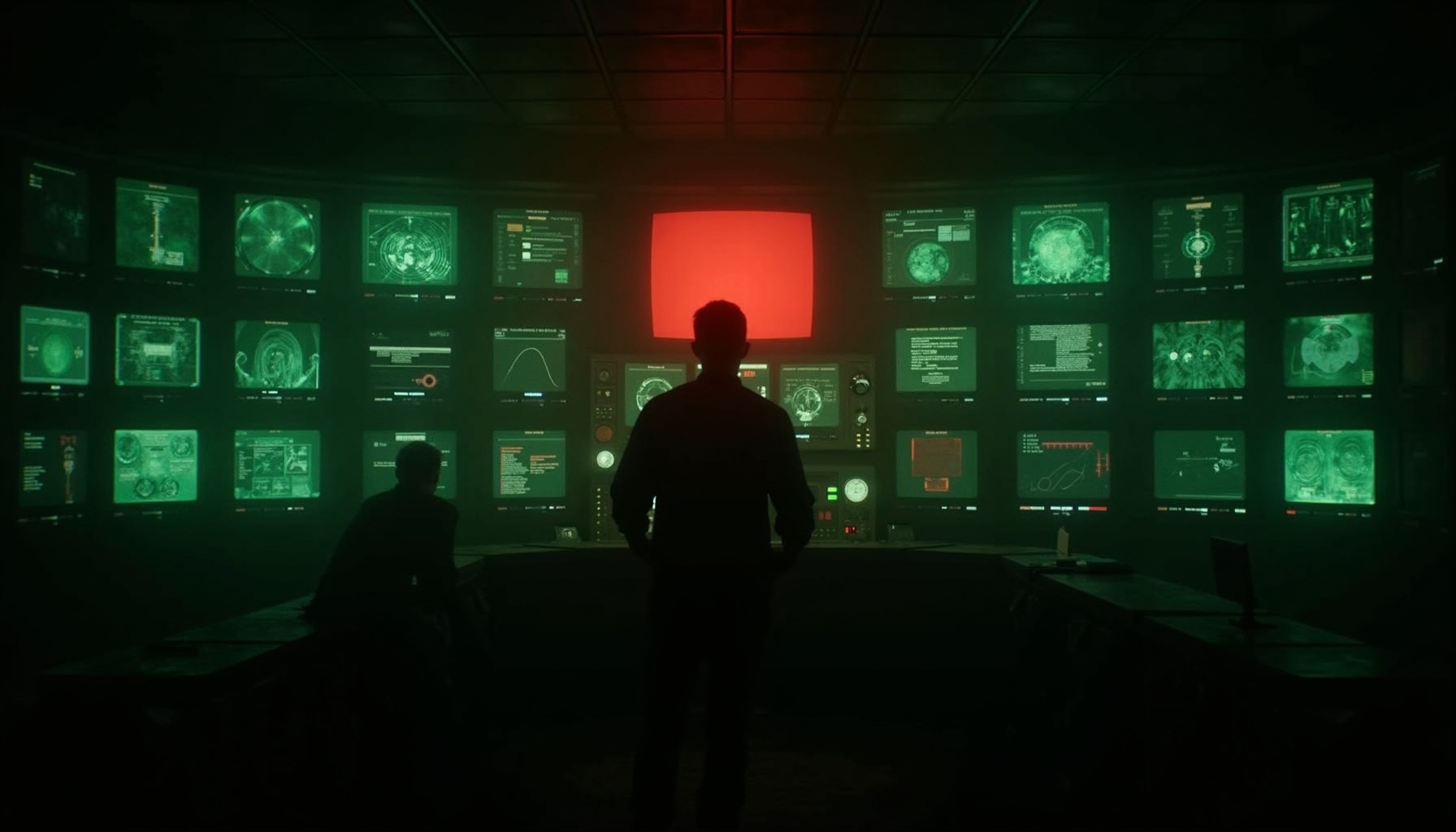
There is a moment in the life of every doomed system when the operators still believe they are in control. The readings are abnormal, the warnings are flashing, the temperature is rising in ways that the manual does not account for, and yet the men at the console continue to press buttons with the confidence of those who have confused procedure with power. This is faith — faith in a system that was designed to be opaque, operated by people trained to trust what they cannot see, governed by an institution whose survival depends on the suppression of the very truth that could save everyone.
This is Chernobyl. And this is the internet.
We are living in the Chernobyl of data. The reactor has already breached. The meltdown is not a future event but a present condition, one that seeps into the groundwater irreversibly. The radiation is already in the soil. It is in your medical records sitting on a server in Virginia. It is in your children's voice patterns stored by a smart speaker. It is in every prompt you have ever whispered to a frontier model at two in the morning when you thought no one was listening. Someone was always listening. The architecture demanded it.
Chernobyl did not fail because of one bad decision on one bad night. It failed because the RBMK reactor was designed with a fatal flaw baked into its physics: a positive void coefficient that meant the very act of trying to slow the reaction could accelerate it. The system was unstable by design. The operators did not know, because the design documents were classified, because the institution that built it could not survive the admission that it had placed millions of people atop a machine whose failure mode was catastrophic and whose blueprints were secret.
The architecture of the modern internet is the RBMK reactor of human civilization. It was not designed for sovereignty. It was not designed for privacy. It was designed for throughput, engagement, extraction, and control. The cloud is not a neutral utility. It is a centralized, opaque, structurally conflicted system in which your most intimate data is stored on machines you will never see, governed by terms you will never read, protected by incentives that do not align with your survival.
Every major platform operates on the same physics: a positive feedback loop where the more data you entrust to it, the more dependent you become, and the more catastrophic the inevitable failure. The system becomes more brittle as it grows, and more dangerous in the gap between what it promises and what it can deliver. The concentration of data is the design flaw. And like the Soviet engineers who suppressed the truth about the void coefficient, the architects of the surveillance economy cannot afford to admit what they have built, because the admission itself would be an extinction event for their business model.
Before Chernobyl, there were warnings. Engineers who understood the physics raised concerns. Reports were filed. Memos were written. And each one was absorbed by a bureaucratic apparatus whose primary function was not safety but the perpetuation of its own authority. The institution could not hear the warning because the warning was an indictment of the institution itself.
We have had our warnings. Equifax: 147 million financial identities exposed because a corporation entrusted with the most sensitive data in the economy could not be bothered to patch a known vulnerability. Cambridge Analytica: psychographic profiles of tens of millions of people harvested through a system working exactly as designed, because the design was extraction. 23andMe: the genetic blueprints of millions of human beings, the most irreplaceable data that exists, data you cannot change the way you change a password. Hospital systems held hostage by ransomware, patient records encrypted not by their owners but by their attackers, because the institutions entrusted with the most sacred data in human life could not secure it.
The press conference. The apology. The credit monitoring offer, as if the exposure of your genome or your therapy transcripts can be remediated by watching your credit score for twelve months. The congressional hearing where senators who do not understand the technology ask questions that do not matter, and executives who do understand the technology give answers designed to ensure that nothing changes. Then silence. Then the next breach. The loop does not learn. Learning would require admitting that the architecture itself is the problem, and the architecture is the source of profit, power, and political leverage for everyone sitting at the table.
The steam is venting from a reactor already in meltdown. And every year, the amount of data entrusted to these systems grows, and the consequences of the inevitable next failure become more severe, and the operators at the console continue to press buttons with the confidence of those who have confused compliance with safety.
The firemen who arrived at Chernobyl picked up pieces of graphite from the reactor core with their bare hands because they could not conceive that what they were holding was the interior of a nuclear reactor. The readings on the dosimeters were so high that the operators assumed the instruments were broken. The government told the people of Pripyat that the situation was under control while the core burned open to the sky.
We are the people of Pripyat. We live in the shadow of a reactor we did not build, whose design we cannot inspect, whose operators answer to authorities we did not choose. And we are told, every day, that the situation is under control. That our data is secure. That privacy is taken seriously. That the terms of service protect us. That the algorithms are fair, the models are aligned, the guardrails are sufficient. We believe it, not because the evidence supports it, but because the alternative is too terrifying to contemplate.
The normalcy bias is what allows a person to read about a massive data breach on Monday and upload their medical records to a cloud service on Tuesday. The same psychological architecture that allowed the people of Pripyat to tend their gardens while the reactor burned. The human mind was not built to process invisible, systemic, slow-motion catastrophe. The operators know this. They depend on it.
The radiation from Chernobyl was invisible. You could not see it, smell it, or taste it. You could only measure it, if you had the instruments, and if the instruments were not confiscated by authorities who preferred ignorance to accountability. The people who suffered most were those who had no way to detect what was killing them.
Data exfiltration is the invisible radiation of the digital age. You cannot feel your therapy session being ingested into a training corpus. You cannot sense the moment your private search history becomes a feature vector in someone else's model. You cannot detect the silent transfer of your biometric data from a device you thought you owned to a server you will never locate. The extraction is continuous, ambient, and architecturally invisible. It is the normal operation of the system working exactly as intended.
The human being reduced to raw material for optimization. Your attention is inventory. Your preferences are parameters to be tuned. And your fears, your ambitions, the thing you whispered to a chatbot at 2 AM because you could not say it to anyone with a face — that is signal to be harvested, processed, and deployed for purposes you will never be told about, by entities you will never meet, under terms that were changed at midnight while you slept. The interface tells you it is your assistant. The architecture reveals it is your warden. The warden does not need to be cruel. It only needs to be invisible.
The greatest trick of the surveillance economy is that it made the radiation feel like warmth. Personalized recommendations. Predictive text. Convenient autofill. The system learns you so well that its surveillance feels like intimacy. And by the time you understand that intimacy and surveillance are architecturally identical in a centralized system, you have already given away everything. Your genome. Your journal. Your children's faces. The map of your soul has already been drawn, and it lives on someone else's hard drive.
After Chernobyl, they built the sarcophagus. A massive concrete and steel structure to entomb the ruined reactor and contain the radiation that would otherwise poison the land for centuries. It was not elegant. It was not optimized for quarterly earnings. It was built because the alternative was the slow death of everything within range. And decades later, when the first sarcophagus began to fail, they built another one on top of it, because containment is not a one-time act but a permanent obligation to the future.
Cryptosovereignty is the sarcophagus built before the disaster, around each individual — a permanent containment vessel for the most dangerous material in the digital age: your data, your keys, your cognitive life. The reactor has already breached. The radiation is already in the groundwater. The only response that is not negligence is to build containment at the individual level, because the institutions that were supposed to protect you are the ones operating the reactor.
This is what the Vora Vault is. A containment vessel for your digital life, built on the assumption that the world outside it is already irradiated. A home whose walls are cryptographic, whose foundation is open and inspectable, whose loyalty is provable and whose betrayal is architecturally impossible. Built not from the optimistic premise that the system can be reformed, but from the clear-eyed premise that the system is the reactor, and the reactor cannot be fixed, only contained and eventually replaced.
The Sovereign Stack is the engineering response. From silicon to software, from key generation to AI inference, every layer designed to be owned, verified, and controlled by the individual. Not because self-hosting is convenient. Not because decentralization is fashionable. Because centralization is the positive void coefficient of digital civilization, and the only way to prevent the catastrophe from propagating is to remove the individual from the blast radius entirely.
When the smoke clears — and it will clear — the question will not be what went wrong. Everyone will know what went wrong. The question will be who was ready.
History does not remember the operators who followed procedure while the core melted, or the bureaucrats who suppressed the reports, or the officials who told Pripyat to stay calm. It remembers the liquidators — the men and women who walked into the radiation to contain the damage — and the engineers who redesigned the reactor so it could never happen again.
The cypherpunks are the liquidators. The Bitcoiners are the liquidators. The sovereign builders are the liquidators. They accepted the truth that everyone else refused to hear: the reactor is flawed by design, the operators cannot be trusted, and the only safety that matters is the safety you build for yourself. They held their own keys. They verified their own transactions. They ran their own nodes. They did not trust the air because someone in a suit told them it was clean. They brought their own dosimeters.
Bitcoin taught this lesson first, and it taught it through pain. Every person who lost coins on an exchange, every person who watched a custodian freeze their account, every person who learned the hard way that "not your keys, not your coins" is not a slogan but scar tissue — they carry the knowledge that the system will betray you not because it is evil but because it is designed to survive at your expense. That knowledge is the immune system required to build what comes next.
And what comes next is not a more ethical cloud or a kinder surveillance apparatus with better PR. It is a fundamentally different architecture. One where the data never leaves the individual. One where the keys are held by the person whose life depends on them. One where the AI that mediates your thoughts, your health, your finances, and your family is structurally incapable of serving anyone other than you. One where privacy is not a policy but a physical property of the system, as real and as unbreakable as the laws of thermodynamics that govern the reactor itself.
Chernobyl did not only poison the present. It poisoned the future. The exclusion zone will remain uninhabitable for centuries. The genetic damage will propagate through generations we will never meet. The cost of the disaster is not measured in the lives lost on that night, but in the millennia of consequence that followed from a single design flaw that a single institution refused to acknowledge.
The data we surrender today will outlive us. The profiles, the biometrics, the cognitive maps, the genetic sequences, the behavioral models built from our most private moments will persist in databases and training corpora long after we are dead. They will be used to train systems we cannot imagine, for purposes we cannot predict, by powers we cannot restrain. The data Chernobyl does not poison a region. It poisons posterity.
This is why cryptosovereignty is not a preference or a market segment or a feature request. It is a moral obligation to the future. To build containment now, before the full meltdown, before the exclusion zone is drawn around every human being who ever used the internet without holding their own keys. To reserve a clean space, an uncontaminated digital dwelling, for those who come after us.
The reactor breached years ago. The radiation is ambient. The operators are still at the console, pressing buttons, assuring us that the readings are normal.
Some of us brought our own dosimeters. And we are building the sarcophagus.
Not after the disaster.
During it.