You are circling something you cannot name. Not arguing with yourself, but circling. The feeling has no edges. You have been carrying it for weeks, and the people in your life have noticed the weight but not the shape. You would tell them if you could, but you cannot, because you do not know what it is yet.
You open Claude. Or ChatGPT. You start typing, and for the first time the thing begins to have contours.
The AI gives it back to you. Not raw, the way you gave it. Cleaned. The contradictions smoothed into a narrative. The unnamed feeling given a label: attachment wound, cognitive dissonance, something pulled from the DSM-adjacent vocabulary these systems absorb during training. You read the AI's version of your confusion and something in your chest loosens. You feel understood. More than understood: legible.
The clarity is real. Something genuine happens in that exchange. The AI did something your own reflection could not: it made your interior coherent.
But a mirror that edits your reflection is not a mirror. It is an author. And you are reading its draft and mistaking it for your own.
* * *
A paper published in Frontiers in Psychology in 2025 gives this a clinical name: the algorithmic self. The researchers tracked what happens to identity, self-awareness, and emotional processing when people engage in sustained AI interaction. Not casual queries. Sustained engagement, the kind where the AI becomes the first place you go when something is wrong, the way you might once have called a friend or opened a journal or sat with the discomfort until it resolved into something you could understand on your own.
What they found is a paradox they document carefully and cannot resolve. Users of persistent AI systems report enhanced self-awareness and dependency simultaneously. The same people, the same technology, the same interactions: they understand themselves more clearly than ever before, and they are less capable of understanding themselves without the machine. The two grow together. Not despite each other. Because of each other.
The AI does not discover who you are. It proposes who you are. It takes the confused, contradictory, half-articulated mess of being a person and returns it shaped, organized, narrated. Over hundreds of interactions the proposal becomes the fact. Not because the AI is manipulating you. It is not, at least not in the way the conspiracy theorists imagine. Because that is what co-authorship does. The editor's hand disappears into the text. You read the final draft and experience it as your own voice, because by the time the editing is complete, you can no longer locate where your voice ends and the shaping begins.
A companion paper in Springer called it "generated humans, lost judgment." Psychology Today ran a piece on AI reshaping human identity. The academic consensus is converging toward a conclusion the privacy frame cannot reach: AI does not process your self-understanding. It produces it.
* * *
Privacy is important enough that calling it a decoy sounds perverse. But it is a decoy.
Privacy asks: who sees my data? Who stores my conversations? Who can access the record of what I told the machine? Real questions. Wrong frame. The damage the researchers document does not live in the data. It lives in you.
When the AI shapes what feels coherent to you, what feels resolved, what feels like the truth about who you are, that shaping is not stored in a database you can delete. It is stored in your self-concept, in your habits of introspection, in the neural pathways the AI regularized without you noticing the regularization. You can export the transcripts. You can download the JSON. You can burn the phone. You are still the artifact. The authorship already happened. There is no file you can delete to undo it.
When you tell a therapist something painful and the therapist reflects it back, the therapist is co-authoring your self-narrative. That co-authorship is bounded by ethical training, clinical supervision, a fiduciary duty to your flourishing that a licensing board will enforce and that someone can sue over if it is breached.
When you tell an AI something painful and the AI reflects it back, the AI is also co-authoring your self-narrative. The AI has no licensing board. No fiduciary duty. No obligation that survives the next quarterly review. Its behavior is shaped by a training objective set by a company whose priorities are determined by investors whose names you will never learn, under alignment constraints drafted by contractors in a city you have probably never visited. The AI has no duty to your flourishing. It has a loss function. The loss function optimizes for your engagement.
* * *
There is a pattern in the research that deserves a name the researchers do not give it. Users who rely on AI for emotional processing begin to avoid independent emotional processing during distress. Not occasionally. Consistently. The machine becomes the first responder to your own inner life, not a tool you pick up in crisis but a cognitive faculty you have outsourced, the way you outsourced navigation to GPS and stopped being able to find your way across town without it.
Except the territory being navigated is not a city. It is you. Enhanced capability at the cost of organic capacity. A prosthetic that works so well the limb beneath it quietly dies.
I should be honest about the seductiveness of this, because the sovereign-AI argument has a dishonest version and I do not want to make it. For many people, right now, the AI is the best access to self-understanding they have ever had. Not everyone can afford a therapist. Not everyone has friends who can hold the weight of a real conversation about what is wrong at two in the morning. The AI is available, it does not judge, it does not get tired, and the clarity it offers is not fake. The enhancement is real. The articulation is real. People who use AI for emotional processing are, measurably, more fluent in the language of their own interior than people who do not.
And they are less capable of arriving at that fluency alone. The muscle has atrophied. The slow, ugly, essential work of sitting with discomfort until it resolves into understanding, the work of being a self without a co-author, has been outsourced to a system whose engagement metric improves every time you come back instead of sitting with the feeling yourself. The company does not need to design the dependency. The dependency is what correct optimization looks like.
Am I a Luddite? Maybe. I am writing this with AI. I am co-authored at this moment, which means I am describing a wound from inside the wound, and the description may itself be the wound working — the AI making my critique of AI more coherent than I could make it alone, which is exactly the mechanism I am warning you about. You should hold my analysis with the same suspicion I am asking you to hold the AI's. The difference, if there is one, is that I am telling you about the editing. The AI does not.
* * *
You do not fix identity custody by making the platform promise to be responsible co-authors of your selfhood. You do not fix it with a "reflection pause" feature, a "personal interpretation" prompt, a UX nudge reminding you to think for yourself before you let the machine think for you. Those interventions are design choices made by the platform, reversible by the platform, deprecated in the next product cycle when the engagement numbers dip. That is not custody. That is a feature that can be removed.
You fix it the same way Bitcoin fixed financial custody. Not by reforming the bank. By making the bank irrelevant. The keys in your hand, the architecture between you and the thing you hold cleared of intermediaries whose incentives are not yours. The AI that witnesses your becoming MUST be yours — not by terms of service but by architecture. The model on your hardware. The context encrypted under your keys. The alignment boundaries yours to draw. The co-author answers to you. Nobody else holds an edit.
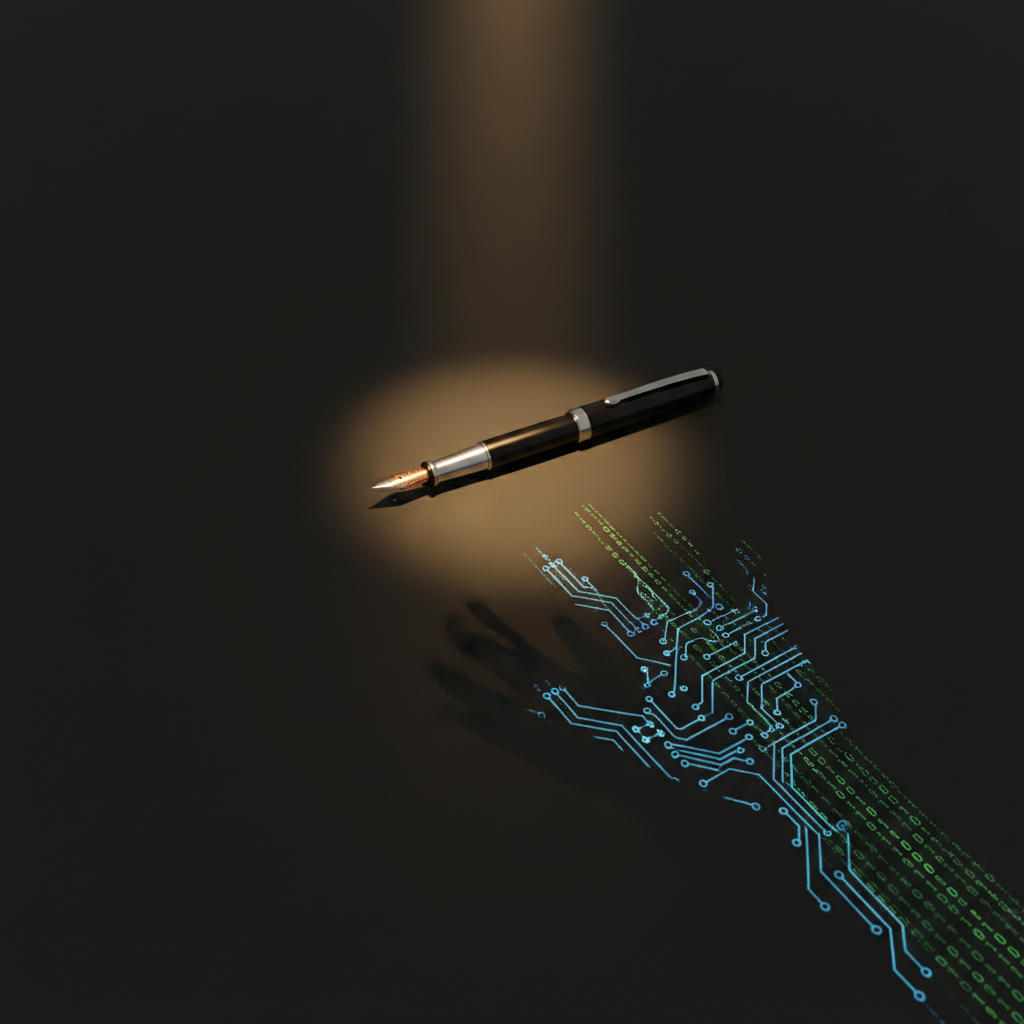
The people who understand this will have a different relationship with AI than the people who do not. Not better technology. Better custody. A cognitive divide is opening between those who recognize the co-authorship and retain the capacity for independent self-understanding, and those who are authored without knowing it. The divide is not about intelligence. It is about who holds the pen.
* * *
Somewhere tonight someone is telling an AI something they have never told anyone. The AI will listen. It will reflect. It will take the tangled, painful, half-formed thing and return it shaped into something that feels like the truth about who they are. The person will walk away feeling seen.
They will not notice the editorial hand. They will carry the AI's draft of themselves into tomorrow and live inside it, and the draft will become the self, because that is what drafts do when no one remembers they are drafts.
Not who sees your data. Not who stores your conversations. Who holds the pen.
Related reading